
Bullion merchants said increased buying by jewellers and retailers to meet wedding season demand and a firming trend overseas where gold surged to one-month high, mainly boosted the sentiment.

From the Sensex firms, Tech Mahindra, NTPC, Tata Steel, Maruti, Infosys, Power Grid, Larsen & Toubro, Axis Bank, Titan, Reliance Industries, Wipro and Mahindra & Mahindra were the biggest gainers. Sun Pharma, UltraTech Cement, Tata Motors, Kotak Mahindra Bank, Bajaj Finance, State Bank of India and Nestle were among the laggards.
.jpg)
Silver declined by Rs 200 to Rs 38,550 per kg.

Invest with a 5 to 7 year horizon so that you are able to ride out price volatility and benefit from the long-term trends of demand and macroeconomic shifts.
Power Grid was the biggest gainer on the Sensex chart, rising 2.54 per cent, followed by Tech Mahindra, Bajaj Finance, NTPC, UltraTech Cement, Larsen & Toubro, Tata Steel, Bharti Airtel, Bajaj Finserv and HCL Technologies. In contrast, Mahindra & Mahindra, Hindustan Unilever, Infosys and Titan were among the laggards.
Among the Sensex firms, UltraTech Cement, JSW Steel, Tata Motors, Bharti Airtel, State Bank of India, Larsen & Toubro, Infosys and Bajaj Finserv were the major gainers. On the other hand, NTPC and Tech Mahindra were the laggards.

Gold seems to be losing its glitter in India due to a rise in prices. Demand in Q2CY24 was 149.7 tonnes - a 5 per cent drop compared to 158.1 tonnes in the same period last year, according to a report by the World Gold Council (WGC). Demand by value in April-June 2024 stood at Rs 93,850 crore, up by 14 per cent compared to Rs 82,530 crore in the same period last year.

'The jury panel said that my collection should not be limited to a college fashion show; it had much more potential. They encouraged me to sign up for the annual National Designer Awards organised by the World Designing Forum.'

India stares at the risk of an influx of Chinese products as US tariffs on a range of Chinese goods, including solar panels, electric vehicles, lithium-ion batteries, syringes, and steel, are set to take effect from September 27. With higher tariffs reducing China's access to the US market, there is concern that China may divert its exports to other markets, including India, which could lead to potential dumping of goods. This situation could challenge Indian industries, particularly in sectors where competition with Chinese products is already fierce.

Gold in Singapore, which normally sets price trend on the domestic front, fell by 0.3 per cent to $1,180.78 an ounce.

'We suggest investors with suitable risk appetite to consider allocating 40-50 per cent in large-caps, 25-30 per cent of funds in quality mid and small-caps and the rest in debt and high yield products.'

IndusInd Bank was the top gainer in the Sensex pack, rising nearly 6 per cent, followed by Axis Bank, SBI, Maruti, Tech Mahindra and Reliance Industries. NSE Nifty surged 183.70 points to close at 17,166.90.

'We believe 2017 could see higher flows from foreign institutions as money comes back to growth markets like India.'

Gold prices recovered by Rs 210.

Investors are showing some interest in the downstream energy cycle. Refiners and marketers, especially the public sector (PSU) oil marketing companies (OMCs) could see a revival of marketing margins. Lower crude oil and gas prices may also improve margins in industries like paints, logistics, synthetic fabrics, plastics, and fertilisers. In the medium-term, however, there could be a supply overhang affecting OMCs as new refining capacities are scheduled to be commissioned, especially in China, and this may lead to a drop in the refining margins as capacity would be surplus to demand until and unless there's a pick-up in global growth.

'If the South starts shooting on IMAX more, it will be beneficial. And likewise, it will benefit Bollywood directors.'

Silver, however, met with resistance and traded lower by Rs 200.

Silver also spurted by Rs 1,000 to Rs 37,500 per kg.
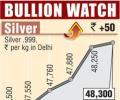
Traders said sentiment remained bullish as stockists increased their positions to meet the seasonal demand.

Benchmark indices started the trade on a weak note on Wednesday with the Sensex falling 564.77 points, following feeble global market trends and persistent foreign capital outflows. The 30-share BSE Sensex was trading 564.77 points lower at 52,612.68. The NSE Nifty dipped 162.4 points to 15,687.80. Among the Sensex pack, IndusInd Bank, Hindustan Unilever, Bajaj Finserv, Titan, Kotak Mahindra Bank and Bajaj Finance were the major laggards in early trade.

Fresher hiring, which has been subdued as Indian information technology (IT) services firms scaled back their recruitment, is set for a turnaround. The IT sector's fresher hiring is expected to rise by 20-25 per cent for 2024-25 (FY25). Additionally, the global capability centres are projected to boost their fresher hiring by 40 per cent compared to last year, according to a TeamLease Digital analysis.

The IT sector's fresher hiring is expected to rise by 20% to 25% for 2024-2025. The increase in hiring is driven by a focus on specialised skills catering to segments like AI, machine learning and data analytics.

Metals bucked the trend and shone across the board.

Iron ore mining major NMDC's results for the April-June quarter (Q1) of FY25 were better than estimates. Weak volumes were balanced off by higher realisations, better average selling price (ASP) and lower royalties which boosted bottomline. The revenue was in line with estimates at Rs 5,400 crore, flat year-on-year (Y-o-Y) and down 17 per cent quarter-on-quarter (Q-o-Q).

India's services sector growth recorded another month of robust expansion in July, albeit at a slightly slower pace than in June, largely supported by robust demand conditions and investment in technology, a monthly survey said on Monday. The seasonally adjusted HSBC India Services Business Activity Index was at 60.3 in July, down only fractionally from 60.5 in June. In the Purchasing Managers' Index (PMI) parlance, a print above 50 means expansion, while a score below 50 denotes contraction.

Equity benchmarks Sensex and Nifty ended on a mixed note on Wednesday as the euphoria about the Budget fizzled out, with investors going for profit-taking ahead of the Fed interest rate decision. The 30-share BSE benchmark Sensex climbed 158.18 points or 0.27 per cent to settle at 59,708.08 after it trimmed most of the intra-day gains. During the day, it had zoomed 1,223.54 points or 2 per cent to 60,773.44.

Although the current long-term bullish trend is intact, markets are awaiting clarity on the taper and the Assembly election results.

Among the Sensex firms, UltraTech Cement, Reliance Industries, ICICI Bank, HDFC Bank, Bharti Airtel, IndusInd Bank, State Bank of India, Tata Consultancy Services, Larsen & Toubro, Kotak Mahindra Bank and State Bank of India were the major gainers. In contrast, Tata Motors, Maruti, Axis Bank, Mahindra & Mahindra, ITC, NTPC, Tata Steel and Bajaj Finserv were the major laggards.

tailwinds of a remarkable year and handsome investor returns, Indian equities are set for an eventful journey in 2024, with a slew of local and global cues -- varying from interest rates to Lok Sabha polls to geopolitical happenings. Analysts are of the view that the bull run in the domestic equity market will continue, and over the next 3-6 months, the benchmark indices -- Sensex and Nifty -- could climb up to 7 per cent. In 2023, the 30-share BSE Sensex jumped 11,399.52 points or 18.73 per cent, and the NSE Nifty climbed 3,626.1 points or 20 per cent.

The rally in PSBs, analysts feel, was more a knee-jerk reaction to the development, and the actual benefits will start to accrue once the addition takes place in 2024. "The actual benefit for banks from the inclusion in JP Morgan's EM Index will accrue from June 2024 onwards. "Until then, the larger fundamentals of the market will dictate the moves. "Once the initial euphoria subsides, bond markets will look to global cues which may trigger fresh selling," said Siddharth Khemka, head of retail research, Motilal Oswal Financial Services.

M&M was the biggest loser in the Sensex chart, falling 6.39 per cent, followed by Tech Mahindra, Nestle India, Bajaj Finance, Axis Bank, ITC, JSW Steel, HDFC Bank and RIL. On the other hand, Sun Pharma, Tata Motors, Bharti Airtel, L&T and Infosys were among the winners, rising up to 2.10 per cent.

'For those looking at forward-looking signals for the economy from the stock markets, the relative performance of small and mid-caps may be a better indicator of the future than the index levels of the narrower and more popular indices', says Neelkanth Mishra.

Benchmark indices Sensex and Nifty retreated from over one-week highs to close lower on Wednesday due to profit booking in banking, IT and metal stocks amid weak global trends. After a two-day rally, the 30-share BSE Sensex dropped by 90.99 points or 0.16 per cent to settle at 57,806.49 in volatile trade. As many as 19 of its constituents declined while 11 advanced. The broader Nifty slipped by 19.65 points or 0.11 per cent to close at 17,213.60 with 31 of its stocks ending in the red.

Will the warning shots from giants like Unilever and P&G break digital growth?

RBI rate cut is a welcome step for all citizens of India as everyone is looking for near-term boost in economy.

As milk prices rise, analysts have an optimistic view on dairy stocks such as Heritage Foods and Dodla Dairy, hoping the companies' margins will grow in the near to medium term. From a long-term perspective, they believe that a growing population, increasing disposable income and health consciousness will strengthen dairy consumption in India.

'Overtightening of monetary policy by central banks and the spread of new Covid variants, which may force governments to restart lockdowns or restrict mobility.'

In a move that may boost the Indian hydrocarbon industry and bring more investments into the sector, the Union Cabinet on Wednesday decided to give marketing freedom to domestic crude oil producers, allowing them to sell petroleum to any company in the local market. The move is set to be beneficial for major crude oil producers, such as state-run Oil and Natural Gas Corporation (ONGC) and Oil India, and private sector majors like Vedanta's Cairn Oil and Gas and Reliance Industries. As of May 31, India was dependent on imports for 86 per cent of its crude oil consumption; domestic production sufficed the remaining 14 per cent demand.

'Earlier-than-expected tapering from the US, followed by rate hikes, and locally, a potential third wave, which mimics the second wave in terms of severity.'

The rupee has been witnessing an unprecedented plunge in its value as it dropped to an all-time intra-day low of 68.75.
